For some inexplicable reason I have always liked motorbikes and sidecars (outfits, chairs or whatever), could be because in my early motorcycling days when I was a gopher for some road racers, I was fascinated by the outfits. Another reason was that I couldn’t afford a decent solo machine.
In the 60`s if you could build your own chassis and tune your engines there was lots of relatively cheap racing to do. When I started there was only British twins and BMWs available, wheels were spoked 16inch shod with Dunlop the only sidecar tyres available.
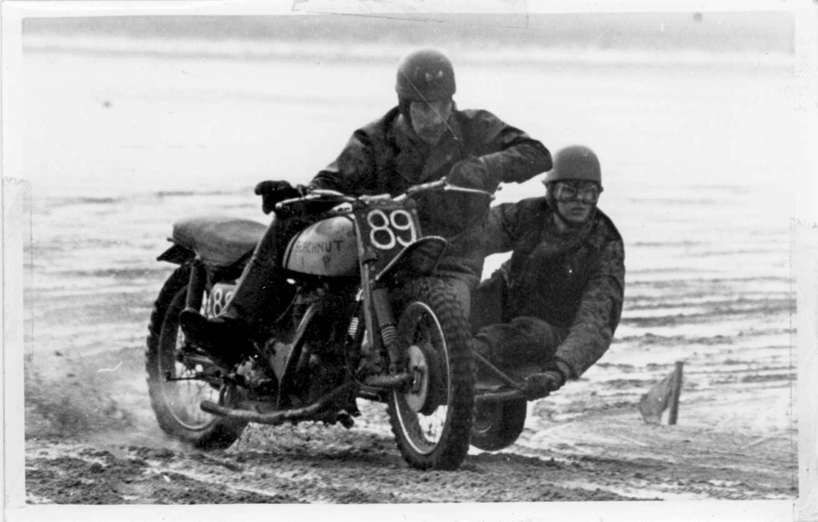
I first started outfit racing on the sand in 1965, at the same time I was passenger on grass track and road race outfits. Most of us used all second-hand bits and pieces; there were no ignition cut out lanyards, no restrictions on fuel type, most used dope an ethanol based fuel. Clothing requirements were limited to crash helmets, very few could afford leathers. We raced on the East coast where all the circuits were left hand bends so we developed light weight sidecars with the bike leant to the left. This allowed us to lift the sidecar wheel down the straights for less drag, but you had to be careful to put it back down before the passenger moved forward for the corners; which were taken in a three wheel opposite lock drift as shown below.
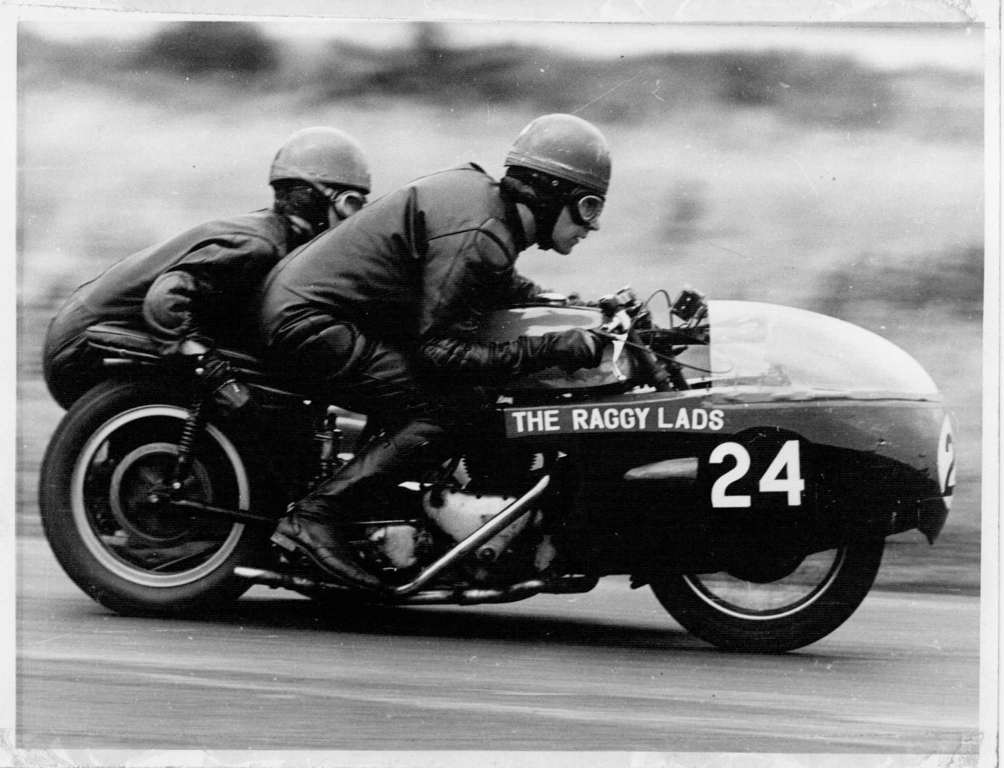
After a few seasons I built a road race outfit using a Norton featherbed frame with 16 inch wheels. Two outfit racers I knew gave me a sidecar chassis and a dustbin fairing. There was no sidecar brake only a BSA 8inch single drum on the front and a Norton 7 inch drum on the back. We used cut down Norton telescopic forks but altered the steering yokes to sidecar trail by removing the top yoke and heating the bottom one and bending it to give the correct trail . The top one was cut into three pieces the bits fitted and then welded up. It steered well better then some who had leading link forks but wrong geometry. For simplicity we kept a sitting position and christened the machine “The Raggylads” due to our lack of funds. We had great fun on this outfit shown below at Silloth circuit (an old aerodrome on the west coast).
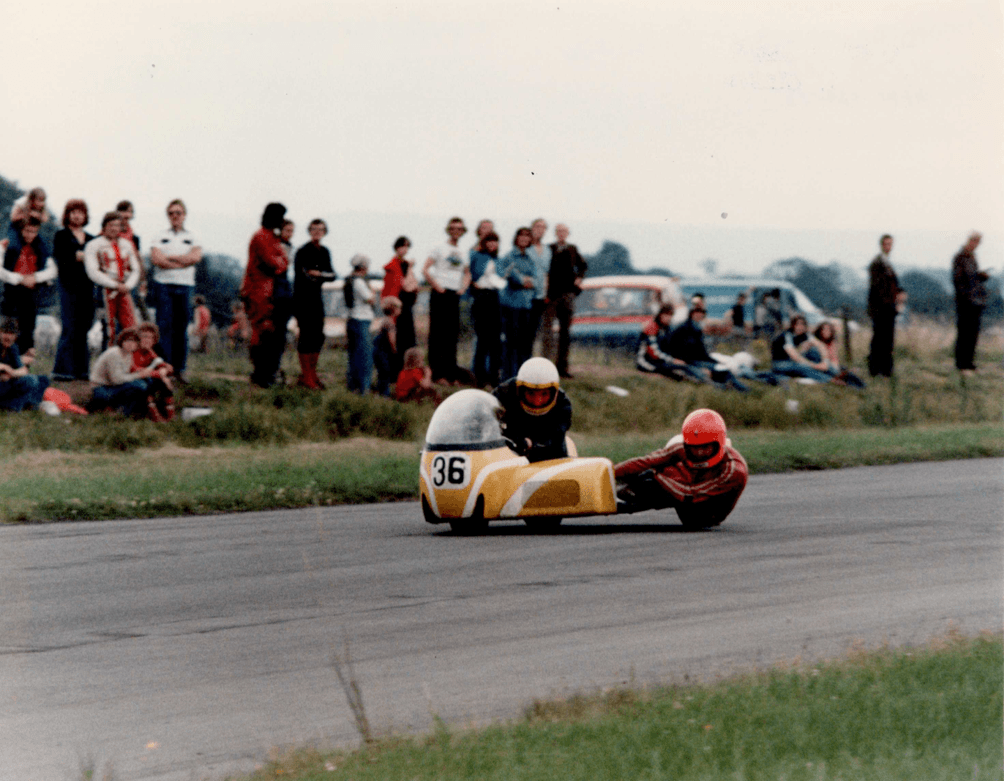
The outfit quickly got modified to a kneeler with a mini back and sidecar wheel, then I bought a better chassis from one of the other crews I knew. This had disc brakes on all wheels and I fitted a Saab three cylinder two stroke engine, by then twins were uncompetitive as Japanese four cylinder engines had arrived on the scene. We ranged from Knockhill, East fortune in Scotland through Silloth, Croft, Elvington, Carnaby and Cadwell Park further south was not only expensive on travel but we were outclassed.
My last outfit I built from scratch using straight tubes for the frame and box section for the leading link forks and swing arm, fitted with a Hillman Imp four cylinder engine. This engine was originally designed and built as a Coventry Climax supercharged V8 formula one racing car engine which was later cut in half detuned and used as pump engines for the forces fire tenders, knicknamed the “Green Goddess”, and later used in the Imp car by Rootes group to compete in the market against the Mini.
We ran this engine on two Weber DCOE weber carbs, the cylinder head was professionally ported and fitted with big valves and a high lift camshaft. The main bearings had bigger studs fitted and these were strapped to the crankcase to give extra support. The cylinder head was machined to allow “Wills rings”(gas filled soft metal O rings) to be used to stop cylinder head water leaks under the higher pressures. The discs were made from 9% Ni steel due to its strength and friction properties, we kept the car clutch and used a U drive to the Norton gearbox, wheels were 10inch front and sidecar with a 13inch rear. Rear suspension was by a mini rubber ball with a Maxi engine damper It was a fast outfit and at the last Battle of Britain meeting in 1981 on the old Croft circuit we finished 4th.
After this I decided racing had become too expensive for me, I couldn`t afford a professionally built chassis or a Yamaha four cylinder engine. My back was suffering from problems and I was travelling for work so I sold up and packed in.
Over the following years I often thought it would be great to have one last go on a racing outfit. At a Yarm bike club meeting I was reminiscing about my racing days and the idea of having a last fling on a racing outfit, when our bike club chairman told me about Greg Lambert who runs a sidecar racing school, to teach people how to drive or passenger an outfit and allow them to progress to their own racing machines. Greg is the only person I have heard of that actually runs a sidecar racing school, I admire his commitment in encouraging people to take up outfit racing. He runs the school at Teesside Autodrome, which being local to me offered an opportunity I couldn`t resist.
I phoned Greg and explained that I was an ex outfit racer and at 78 wanted a day out on a modern race outfit before I got too old to do it. To my amazement he said it was no problem having had people of a similar age under his tuition. Greg has raced on the mainland circuits and at the TT for over 25 years and intends to keep going for years to come. This year he and his passenger won the British championship in their sidecar class.
I turned up on the day which luckily was sunny and dry, to find out I was partnered with Bob Farrington a successful solo racer, who at 73 was taking up sidecar racing.
Greg explained that he would take us round the track as passengers so we could learn the circuit, two experiences for the price of one. He also said that we were there for a fun day out and to learn not to go mad and crash. He made it plain that any misbehaviour would end with being sent off.
After our track introduction Greg went in the chair after explaining that he would wear the ignition cut out and could reach the back brake if he thought we were going into a corner too fast. He also said the clutch was only for setting off and didn`t need to be used after that. The outfit was an ex TT outfit fitted with a Honda 600RR engine, Greg showed us the method of getting into the outfit and lowering ourselves onto the kneeling trays, a lot different to my day when access was needed for push starts.
I found the outfit very light to steer once it was moving, and finished my first session at a steady pace learning more about the track and positioning for the corners. On each session Greg allowed me to go faster and faster giving me tips braking points, corner entry and track position.
At the end of our sessions I was delighted with my performance and grateful to Greg for all his help, tuition and having the goodness to let me have a go. I can recommend this experience to anyone who fancies having a go or wanting to take up sidecar racing. There are lots of classes of sidecar racing one of which is designed to keep costs to a reasonable level, there are others for classic outfit racing.
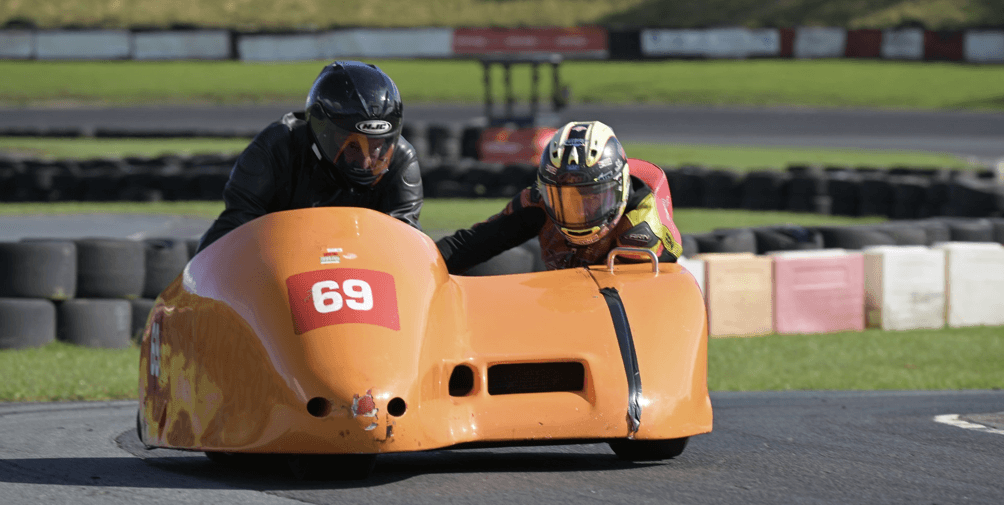
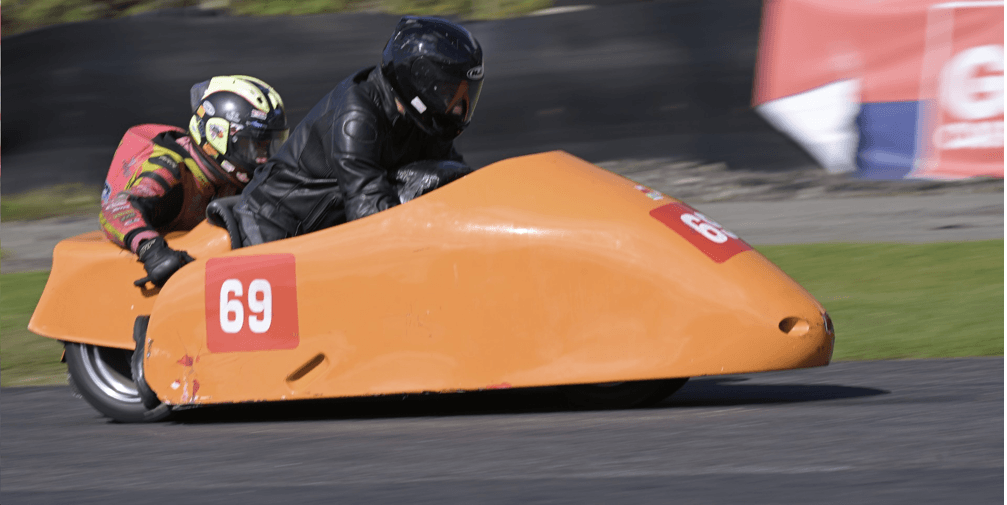
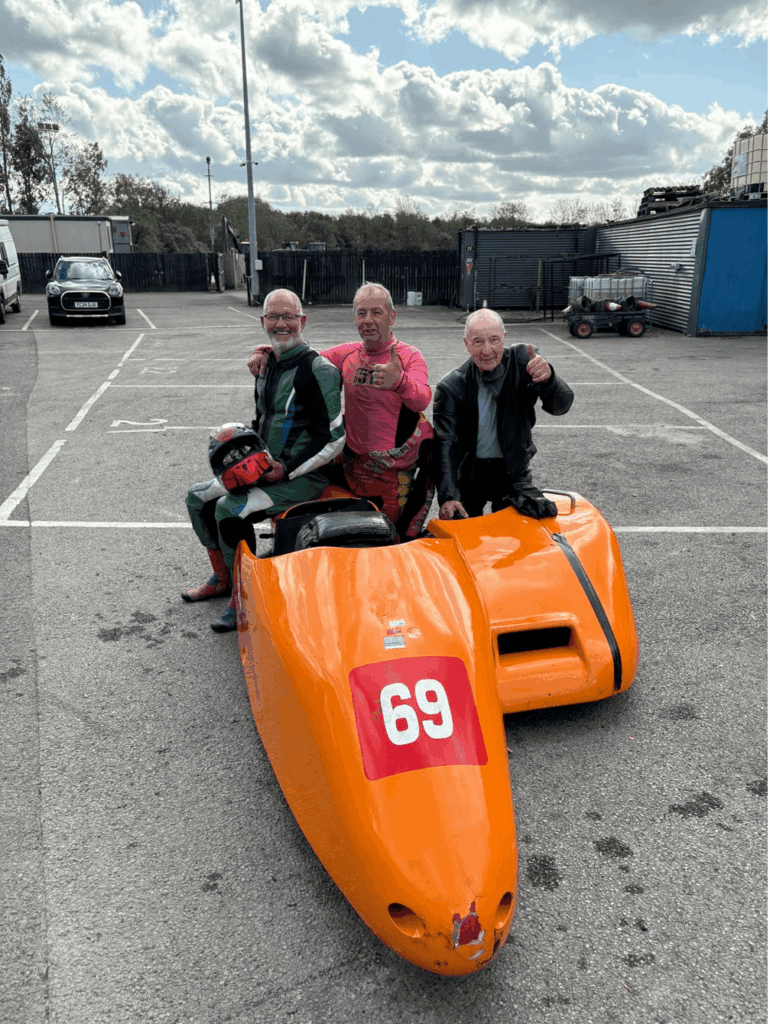
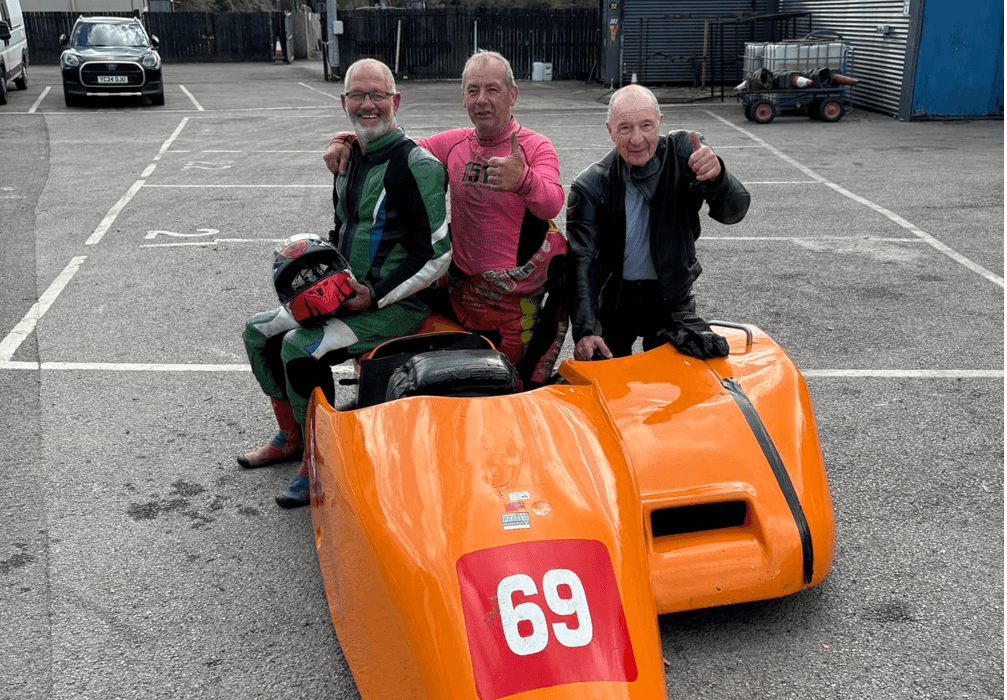
Thanks Greg and Bob for a wonderful day out, the following photographs are of me driving, then with Greg and Bob at the end of our day.